

Disclaimer: Journey Beyond the Horizon is a participant in the Amazon Services LLC Associates Program, an affiliate advertising program designed to provide a means for us to earn fees by linking to Amazon and affiliated sites at no additional cost to you.
Last updated: September 16, 2026 — the article has been substantially revised and expanded with updated geographical and geological information and new destinations.
The natural geography of the Earth has a variety of forms, creating many kinds of landscapes. Mountains, plains, hilly areas, valleys, canyons, situated in various zones of the planet- from the hottest and wettest to the coldest and driest- all they can offer stunning views that can impress people to travel. Some of these forms are exclusive and very specific, creating landscapes that are really unique. One of these kinds of forms is the karst hills areas.
Table of Contents
What is karst?
Karst is a type of landscape formed mainly where water dissolves soluble rocks such as limestone and dolomite, creating distinctive surface and underground landforms. Due to this interaction, the water can change and form the surface in a way that can create formations with unique shapes. Karst is not a rock type itself; limestone is especially suitable for karst formation because slightly acidic water can gradually dissolve it along cracks and fractures.
There are karst areas in the whole world, but the karst rocks react differently in different parts of the planet. In some places, the water forms mostly canyons, in other places- mostly caves (and caves are one of the main karst formations). But there is a place on the Earth, where the karst, water, and local climate are combined in a perfect way so that they formed one of the most beautiful and breathtaking landscapes in the world- the karst (limestone) hills. This place is South China and parts of Southeast Asia.
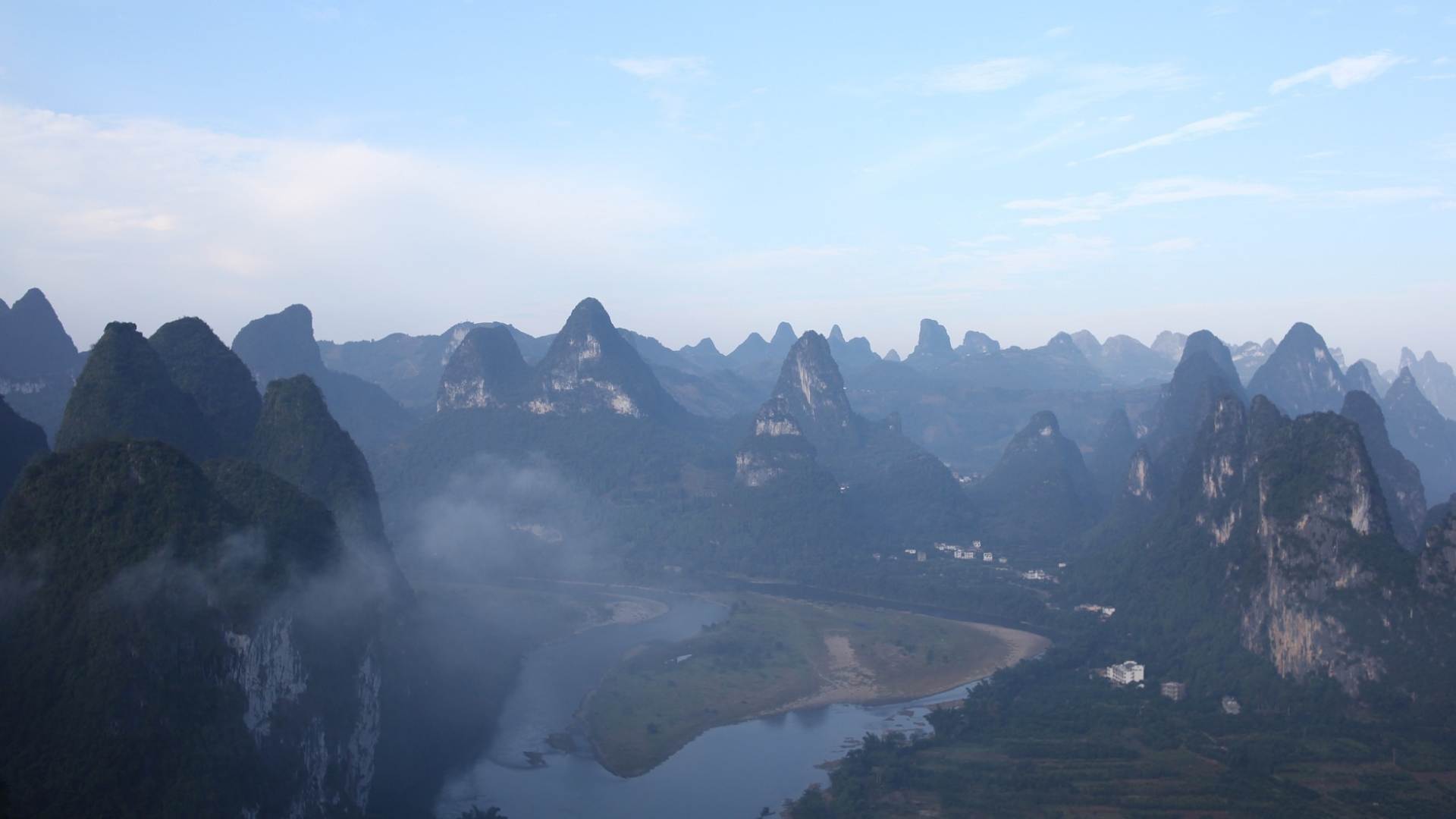
Karst hills landscapes
The karst (limestone) hills can be formed in various shapes, depending on many factors. The three main shapes are conical hills (“fengcong”- 峰丛), tower hills (“fenglin”- 峰林) and stone forests (“shilin”- 石林). And there are a lot of shapes, combined various features of more than one of these three.
Conical hills
The conical hills, called fengcong (峰丛) in Chinese, are clusters of cone-shaped karst peaks separated by enclosed depressions; they should not be understood simply as an ‘early stage’ of karst development. Their shape is like the second Chinese character of their name- “峰丛”. The best example of fengcong conical hills is in Luoping, China, where the hills are scattered on a beautiful plain.
Tower hills
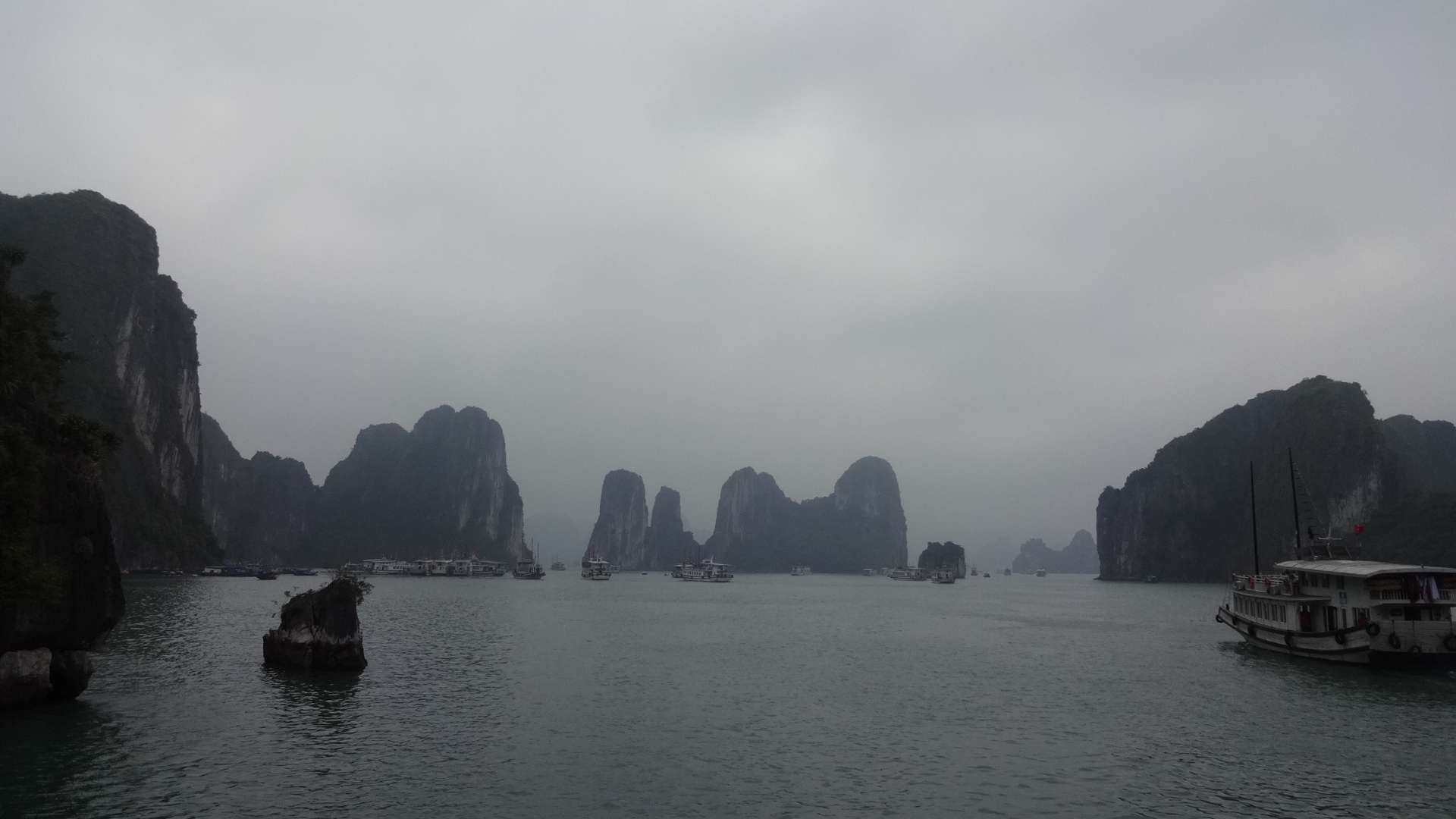
The tower hills, called fenglin (峰林) in Chinese, which means ‘peak forest’ or ‘forest of peaks’, are the most beautiful karst hills, consisting of isolated steep-sided towers rising above relatively flat lowlands. They are present in the most popular karst destinations like Guilin, Halong Bay, and Zhangjiajie.
Stone forests
There are karst formations, where the rocks are cut from above by the water, which has created shapes like erected sharp swords. Stone forests are a distinct type of pinnacle karst, formed by prolonged dissolution along fractures in the limestone rather than simply being broken-down tower hills. The best example of such landscape is again in China, in Yunnan province- the “Stone Forest”.
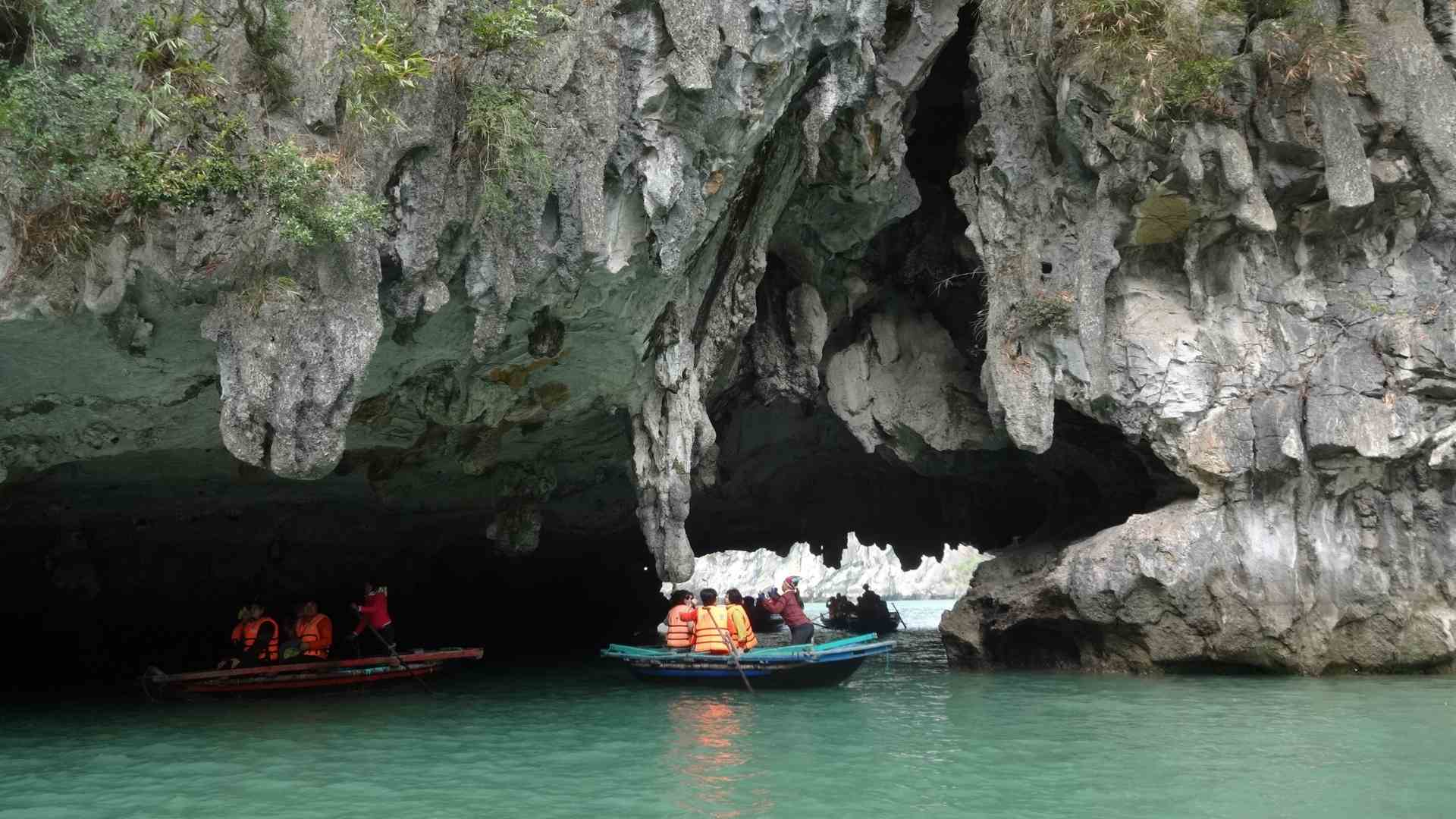
Other karst formations
The playing of the water and rocks has formed many other karst formations, going together with the hills. The most important of them include:
Caves
All karst hills areas normally have caves. Not one or two, but many caves. They are formed by the same water processing which forms the hills. Some of the caves are so large that a whole hill can be hollow inside. The caves can have one or more entrances. There are also many underground rivers, flowing inside the caves. These rivers usually enter a cave in its large entrance (where the tourists usually enter too) but flow out through a small hidden hole. Stalagmites and stalactites are common forms inside the caves.
Tunnels and holes
Some of the caves have collapsed in the past, or have been modeled in more complicated ways, creating strange forms like tunnels and holes. Thus a visitor can enter from one side and go out from the other side. Again, there are often underground rivers, or if the formations are in the sea, you can float through a tunnel and go out appearing yourself in a hidden lagoon.
Coves
There are also many coves, which can be seen on the hills slopes, mainly in the hill’s basic. Stalactites, stalagmites and flowing water can be also often seen inside. Some of the coves are used as small religious shrines.
Canyons
Canyons are another feature of the karst areas. They can be usually seen in more compact karst hills areas, where the water has broken through the mountain body, creating a gorge with slopes which can be vertical like walls.
Ponors
Ponors are karst holes, where the waters sink from an angle deep under the surfaces. There the waters enter an underground river system and go out again like a larger river.
Sinkholes
These forms are depressions, or vertical holes, larger than the ponors. They are usually dry, but when the rain comes, the rainwater sinks into the hole’s cracks in the bottom, proceeding again to an underground river system. Some of the sinkholes are really large, and the largest ones are found in the Chinese karst areas.
 Exploring the Earth is fantastic! However, there are various hidden dangers that may ruin your journeys. Don’t allow that to happen, or at least reduce the consequences as much as possible!
Include a travel insurance as a part of your trip preparation by pressing the button below:
THE 10 MOST BEAUTIFUL KARST HILLS DESTINATIONS
The karst areas in South China and Southeast Asia are large, and you can recognize these areas, when looking at Google Earth by their typical relief form, as a zone of green pimples. These zones in South China, especially in Guangxi province are really large, and inside them, you can find the best karst hills destinations to visit. Some of the most famous karst landscapes in Southeast Asia are on the seacoast, where limestone towers have become islands, but large inland karst regions can also be found in Laos, Vietnam, Thailand, Malaysia and other parts of the region.
See the 10 most beautiful karst hills destinations in South China and Southeast Asia, which are the best in the world, and be inspired!
1.Guilin
Type of karst terrain: fenglin (tower hills) and fengcong (conical hills)
Guilin remains as the most famous of the karst hills areas in China and the world. And it really deserves it. It features not only karst hills landscape with a rich cave system, but in addition, there is a large river and a few smaller rivers. The area is also rich in history and local ethnic culture. All this has made Guilin be a really great destination, one of the symbols of China.
The area is located in the Guangxi Zhuang Autonomous Region, and Guilin is one of its major cities. Li River flows through Guilin and continues south through the famous karst scenery toward Xingping, a historic town in Yangshuo County, and Yangshuo itself. The main attraction is a cruise on the river, from Guilin to these two cities, passing through fantastic karst landscape.
But the area has much more to offer- these three cities are full of old and ethnic style streets and neighborhoods, as well as pagodas, temples, parks and other attractions. Don’t forget the caves which are also very beautiful.

Find your Guilin accommodation here! Find your Guilin Li River cruise here!
Check out some guides, books and other information about Guilin!


2.Luoping
Type of terrain: fengcong (conical hills)
Luoping is a small city in the southeastern part of Yunnan province, near Guizhou and Guangxi. And the area around it features another fairy landscape- Luoping karst hills. This landscape is formed by a large plain as a foundation. And there are numerous conical hills, scattered on the plain.
But the most attractive side of Luoping can be seen at February-March when the plain is covered by endless plantations of canola (rapeseed). Then you can see a vast yellow sea of canola flowers and green conical hills everywhere like islands. Thus during this season, the area becomes a paradise for photographers.

Find your accommodation in Luoping here!
3.Wanfenglin
Type of karst terrain: fenglin (tower hills)
This is one of the largest karst hills areas in the world. And the name of the area means “ten thousand forest peaks” because the tower hills are really numerous. The karst has formed fantastic landscapes, with caves, waterfalls, and valleys.
The main city and starting point for exploring the area is Xingyi, located not far from Luoping but in Guizhou Province. Wanfenglin is divided into East and West Peak Forests. Today Wanfenglin is a major scenic area around Xingyi and, since December 2024, has been officially designated a National 5A Tourist Attraction. Access also improved significantly when Xingyi joined China’s high-speed rail network in late 2025.

Find your accommodation in Wanfenglin here!
4.Rammang Rammang
Type of karst terrain: tower karst
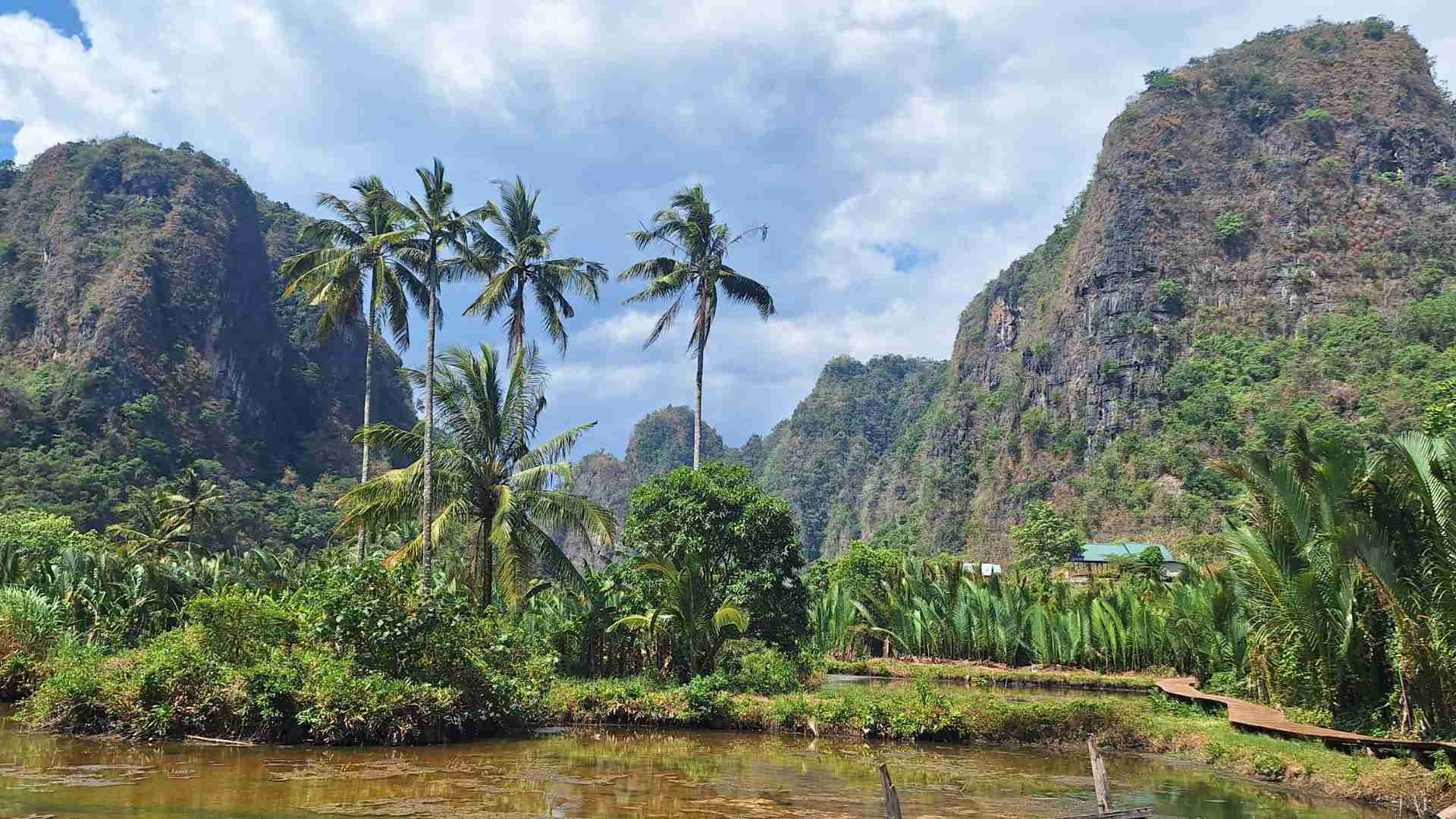
Rammang-Rammang is one of the most beautiful karst landscapes in South Sulawesi, Indonesia. It is part of the much larger Maros-Pangkep karst region, characterized by massive limestone towers rising almost vertically above the tropical lowlands. Since 2023, the area has been included in the Maros Pangkep UNESCO Global Geopark.
What makes Rammang-Rammang especially beautiful is the combination of the karst hills with the tropical rural landscape around them. The limestone towers rise above rice fields, wetlands and traditional villages, while the Pute River winds between the cliffs, mangroves and nipa palms. One of the best ways to explore the area is by a small boat along the river, followed by a walk through the fields and Kampung Berua, deep inside the karst landscape. This combination of tower hills, river, rice fields and tropical vegetation makes Rammang-Rammang very different from the other karst destinations in this list.


5.Halong Bay
Type of karst terrain: fenglin (tower hills), most of them in the sea like islands.
Halong Bay is one of the perfect examples of sea karst hills area, and it is the most beautiful of them. It is located in Northern Vietnam, near Bai Chay city, which is its main starting point to explore. Actually, the karst zone covers a large area in this part of Vietnam, part of which is on the land, and another part- in the sea.
The current UNESCO property of Ha Long Bay–Cat Ba Archipelago contains 1,133 islands and islets, many of them spectacular marine-invaded limestone towers. Many of the islands are hollowed inside by cave systems. Most of the islands are uninhabited; the former permanent floating-village residents of Ha Long Bay were largely relocated to the mainland from 2014, although preserved floating villages, fishing activities and tourism facilities remain on the bay.
Floating between the tower hill islands is a really unique experience. The ships enter in a maze of natural towers, revealing fantastic landscapes behind every hill island. No wonder that this place has become a popular tourist destination and a UNESCO World Heritage Site; since 2023, the protected property has been expanded and is officially known as Ha Long Bay–Cat Ba Archipelago. There are a lot of cruises, arranged by many tour companies, from a few hours to a few days, from budget to high luxury. So you have plenty of options, and if you visit Vietnam, Halong Bay is a must to visit too!

Find your accommodation in Halong Bay here! Find your cruise in Halong Bay here!
Check out some more guides, books and other information about Halong Bay here!


6.Yingxi
Type of karst terrain: fenglin (tower hills) and fengcong (conical hills)
This is another karst hills area, of Guilin-Wanfenglin type. Located in the north part of Guangdong province, it is less known than its “big brother” Guilin. Its main tourist settlements are Jiulong and Huanghua, both within Yingde. The Yingxi Limestone Hills tourist area is centred around Jiulong and Huanghua, while geologically similar karst landscapes continue farther northwest through Yangshan toward Liannan. Its main tourist part is located around Jiulong and Huanghua towns, featuring tower hills, fields, small rivers, a few old villages, caves and rafting spots.
But northwest of Huanghua the tower hills are merged into a compact mountain area with tower peaks. It extends further to Yangshan and Liannan, where the local Yao minority lives and adds another cultural taste of the area. And that’s what makes Yingxi really worth to visit- it is much natural and mysterious than Guilin, being far from the developed tourism and tourist crowds.

Check out some guides, books and other information about Yingxi, Qingyuan and Guangdong province of China!


7.Shilin stone forest
Type of karst terrain: limestone forest.
Shilin is the world’s best example of karst stone forest formation on the Earth. Here the water-stone processing has been different due to the different conditions that in Guilin and Wanfenglin. As a result, the rocks haven’t formed like tower hills but has been chopped as stone pillars. But unlike Wulingyuan’s stone pillars, Shilin’s pillars are tinier, sharper and thicker, like stone swords or teeth.
Shilin is the home of Yi minority, so, as the other karst areas in China, it adds a more special taste of the cultural environment there. The Shilin itself consists of Major Stone Forest and Minor Stone Forest, as well as some lakes and other local natural sites. The Major Stone Forest is one of the principal areas of Shilin UNESCO Global Geopark, while parts of Shilin are also included in the UNESCO World Heritage property South China Karst.

Find your accommodation in Shilin here! Find your trip to Shilin here!
Check out some guides, books and information about Shilin and Yunnan province of China!




8.Vang Vieng
Type of karst terrain: compact mountain with peak forest
Vang Vieng is a small tourist city in Laos, well known with its karst formations and a river, added to the beautiful landscape. Here the karst hills are more compact than those in South China, and not very sharp, but their slopes are magnificent. As in all other karst areas, there are a lot of caves. The narrow valleys between the hill clusters are another stunning feature of the landscape.
This area has been very popular as an area of backpacking parties, with tubing, drinking, drugs and many other party things. But after some death casualties, the government closed most of the bars and seriously limited all dangerous activities. This ended the extreme party scene of the early 2010s, but Vang Vieng has since developed again into one of Laos’ busiest adventure destinations, with tubing, kayaking, caves, viewpoints, hot-air balloons and many other activities.

Find your accommodation in Vang Vieng here!
Check out some guides, books and more information about Vang Vieng and Laos!


9.Chocolate Hills
Type of karst terrain: cone karst
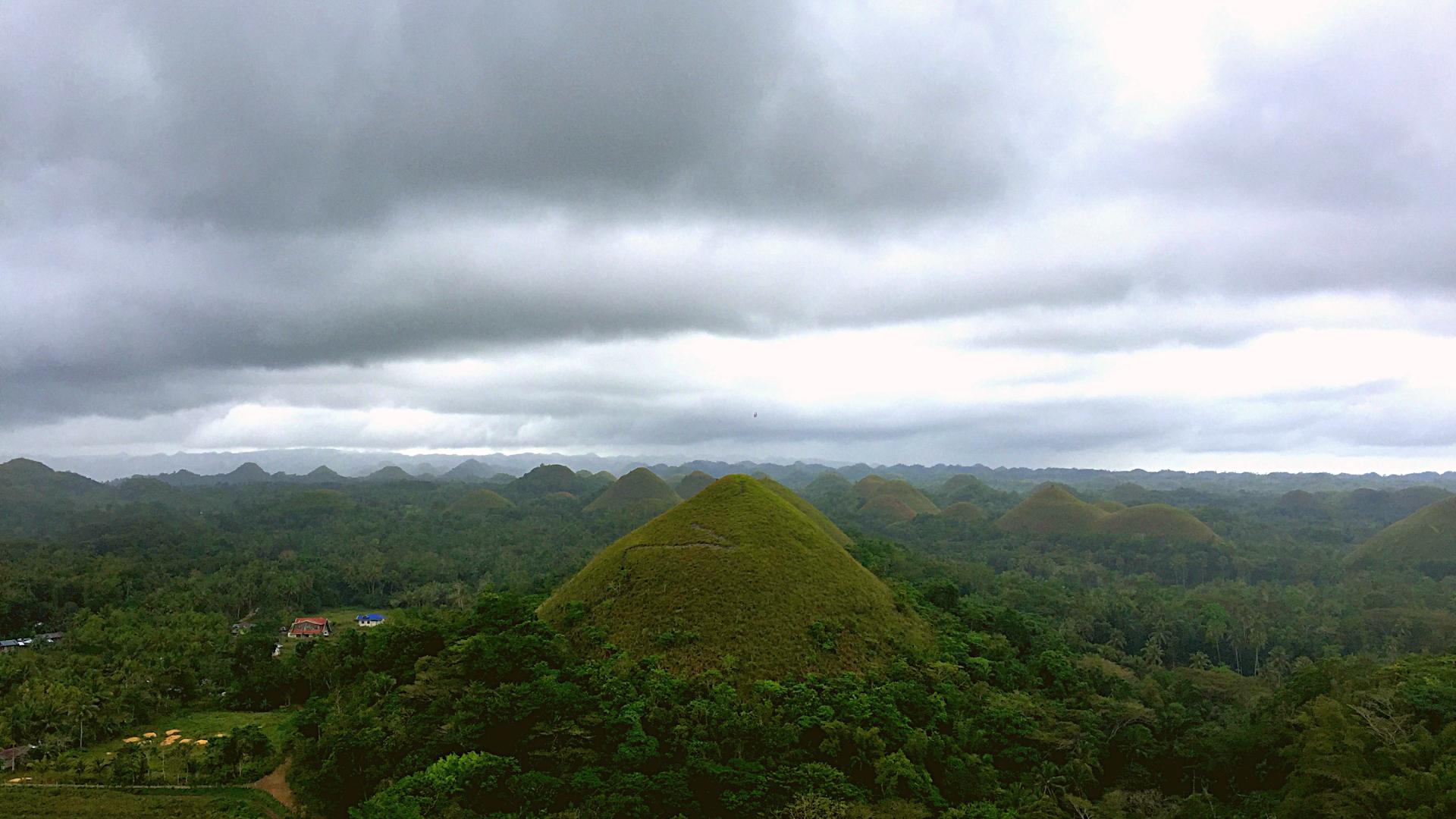
The Chocolate Hills are one of the most distinctive karst landscapes in the Philippines, located in the central part of Bohol Island. More than a thousand remarkably similar conical hills rise above the tropical lowlands, creating a landscape that looks almost unreal. The hills are formed from limestone that developed from ancient coral-reef deposits and was gradually shaped by dissolution and erosion.
Their name comes from the dry season, when the grass covering the hills turns brown and makes them resemble countless pieces of chocolate. During the rainy season, however, the whole landscape becomes bright green. One of the best panoramic views is from the Chocolate Hills Complex near Carmen, where the hills extend toward the horizon in almost every direction. Bohol became the first UNESCO Global Geopark in the Philippines in 2023, with the Chocolate Hills among its most characteristic cone-karst geosites.
I have also explored the Chocolate Hills as part of my journey around Bohol; you can read the full experience in my detailed article about the island and the classical Bohol route: On the classical tour of Bohol Island of the Philippines and beyond.
10.El Nido
Type of karst terrain: fenglin (tower hills) in the sea.
The karst formations in Southeast Asia are not located only in the continent, but also in the islands of Indonesia and the Philippines. The best one of them is El Nido – a tropical paradise at the northern tip of mainland Palawan and the gateway to the Bacuit Archipelago. It is quite similar to Krabi and Halong Bay, featuring the same tower hill formations in the sea. But here you can see more canal and lagoon type coastlines
The Bacuit Archipelago around El Nido contains about 45 islands and islets, surrounded by dramatic limestone cliffs and lagoons. The area is perfect for diving and snorkeling, as well as kayaking in the lagoons and canals. There are also some beaches which, combined with the karst terrain around, form stunning scenery.

Find your accommodation in El Nido here! Find your adventure in El Nido here!
Check out some guides, books and other information about El Nido, Palawan and the Philippines!





There are many other karst areas in South China and Southeast Asia, but their karst hills and rocks features are not the best as the 10 above. That doesn’t mean that they are not beautiful and not worth to visit, just their “power” is in other things- canyons, waterfalls, caves, or ethnic and cultural sites.
The karst hills areas are significant landmarks, real masterpieces of nature, created by God. So, if you make a trip to this part of the world, you really must include at least one of these destinations, which are an important part of the image of China and Southeast Asia.
Conclusion
The above mentioned are the ten best karst and related stone-pillar landscapes in China and Southeast Asia. Furthermore, if you want to see the usual hills surrounded by beautiful mountains, you can consider going either trekking in Nepal, India or Bhutan and visit Ghorepani Poon Hill, Nagarkot, Anantagiri Hills, Ajodhya Hills, Phobjikha, etc.Or you can enjoy many other types of geological formations, such as red stone (“danxia”), wind-formed rocks and many other. Some of them are just unique hilly landscapes, and others are a “prelude” to the highest mountains on Earth. Our planet offers really a lot of amazing real pictures, where you can dive inside!
Want to see more charts of best natural features and go to explore them?
Take a look at the following ones:
Best coral places for scuba diving
Watch how the karst landscapes are formed!
Like it? Pin it here⇓! Follow us in Facebook, Twitter and Instagram!


You may also like


Hi, we are Krasen and Ying Ying. Krasen is from Bulgaria, and Ying Ying is from China. We are passionate about geography and history, and we believe that the best way to experience it is by exploring the Earth in reality, not in a school, and not virtually.
So, we created this blog Journey Beyond the Horizon, where we share geographical knowledge, travel guides and tips how to experience it when you explore our planet, and a lot of inspiration.
And we wish you a happy journey, not just virtually, but most of all- in reality.
Enjoy!
Krasen and Ying Ying
Hi, we are Krasen and Ying Ying. Krasen is from Bulgaria, and Ying Ying is from China. We are passionate about geography and history, and we believe that the best way to experience it is by exploring the Earth in reality, not in a school, and not virtually. So, we created this blog Journey Beyond the Horizon, where we share geographical knowledge, travel guides and tips how to experience it when you explore our planet, and a lot of inspiration. And we wish you a happy journey, not just virtually, but most of all- in reality. Enjoy!


Amazing, I really want to visit Vietnam someday.
Yes, Vietnam is incredibly beautiful! We hope travel will be better and easier, without restrictions, so countries like Vietnam to be more easily accessible. Wish you visit and enjoy Vietnam soon!