
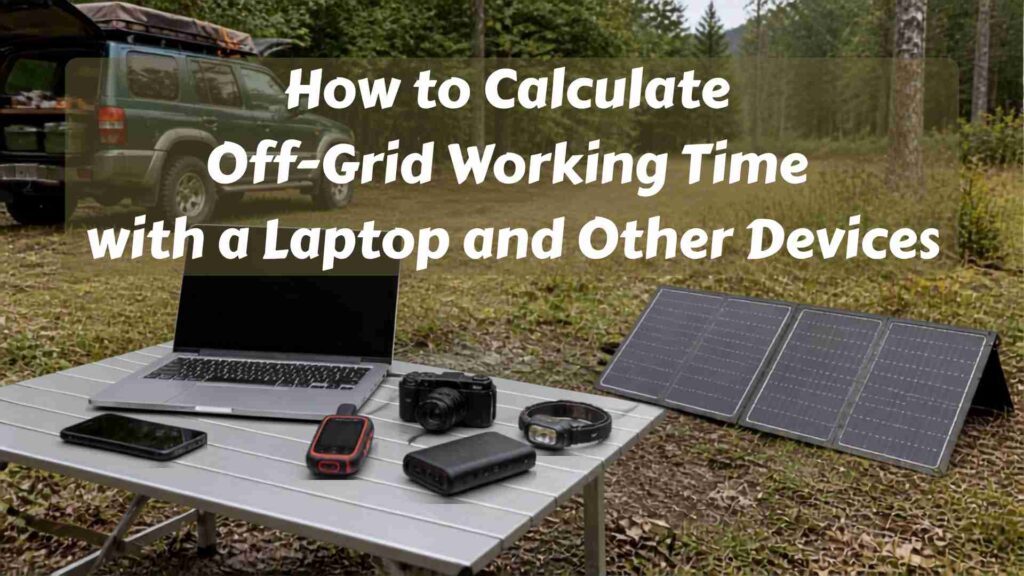
A practical guide to battery capacity, solar and vehicle charging, daily energy use and travel planning.
Working or travelling away from the electrical grid creates a problem that is easy to underestimate. In a forest camp, on a road trip or during a multi-day expedition, electricity becomes a limited resource that must be stored, replenished and divided between competing needs.
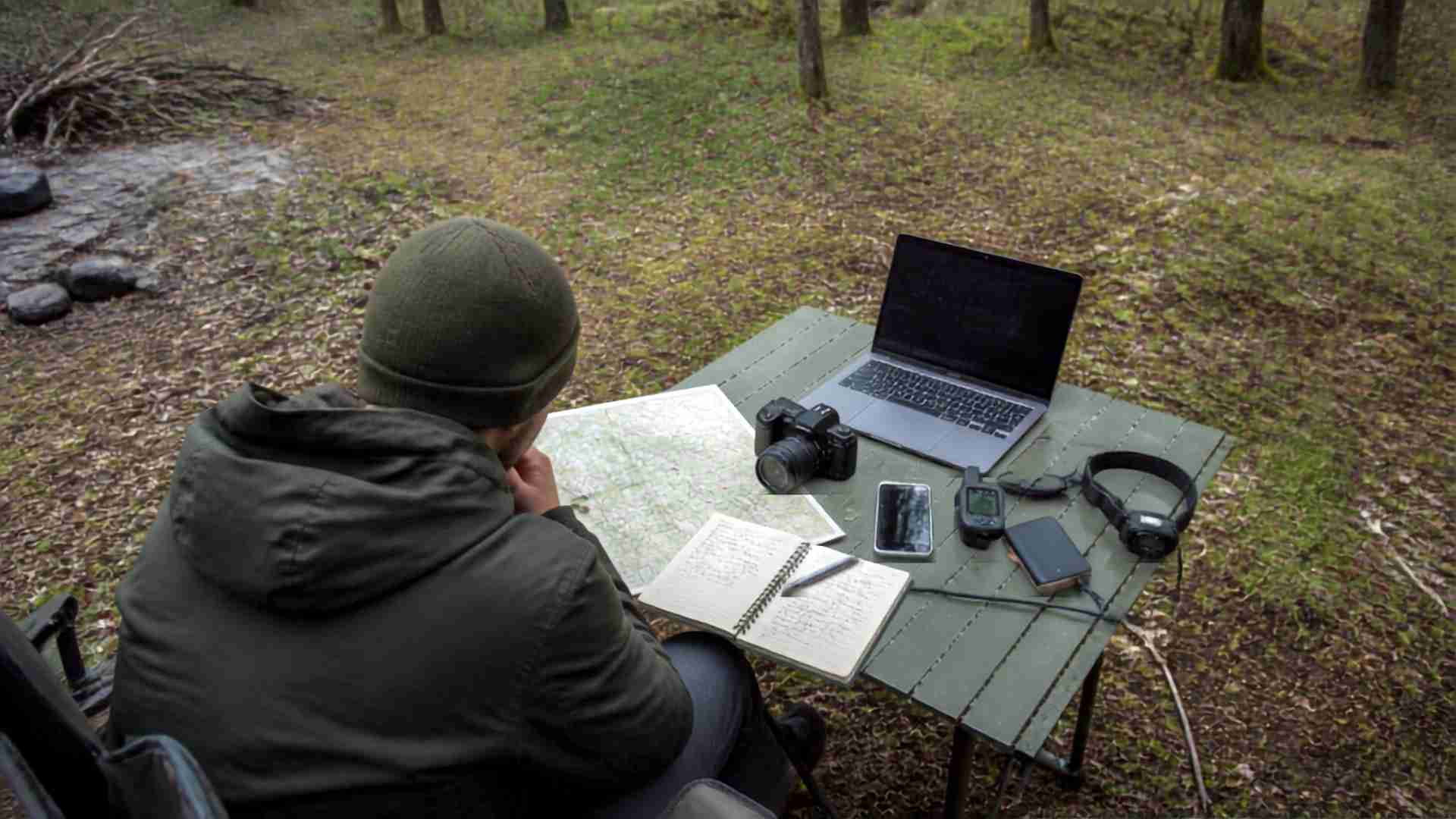
This is not only a concern for digital nomads. A traveller who does not intend to work may still depend on a phone for navigation and communication, a camera or drone, a GPS device, a satellite communicator and a headlamp. Some of these devices are optional; others may be important for safety.
The numbers printed on a power bank, solar panel or charger do not directly reveal how long the complete system will last. This article presents a practical way to estimate what an off-grid setup can realistically support—without turning the subject into a mathematics lesson—and shows how electricity can affect the route, working time and interval between reliable charging points.
Affiliate disclosure: This article contains affiliate links. If you make a purchase through one of these links, Journey Beyond the Horizon may earn a commission at no additional cost to you. As an Amazon Associate I earn from qualifying purchases.
Table of Contents
The off-grid electricity problem
Electricity becomes a travel resource
For a traveller, running out of electricity is not always solved by finding the nearest socket. The next reliable charging opportunity may be hours or days away. Reaching it could require changing the route, driving to a town, booking a hotel or powered campsite, or spending part of the day somewhere that permits charging.
A person at a fixed camp may have time to collect solar energy but little opportunity to charge from a vehicle. Someone driving long distances has the opposite advantage. A hiker faces another limit: every larger battery and panel must be carried over the route.
Priorities compete for the same reserve
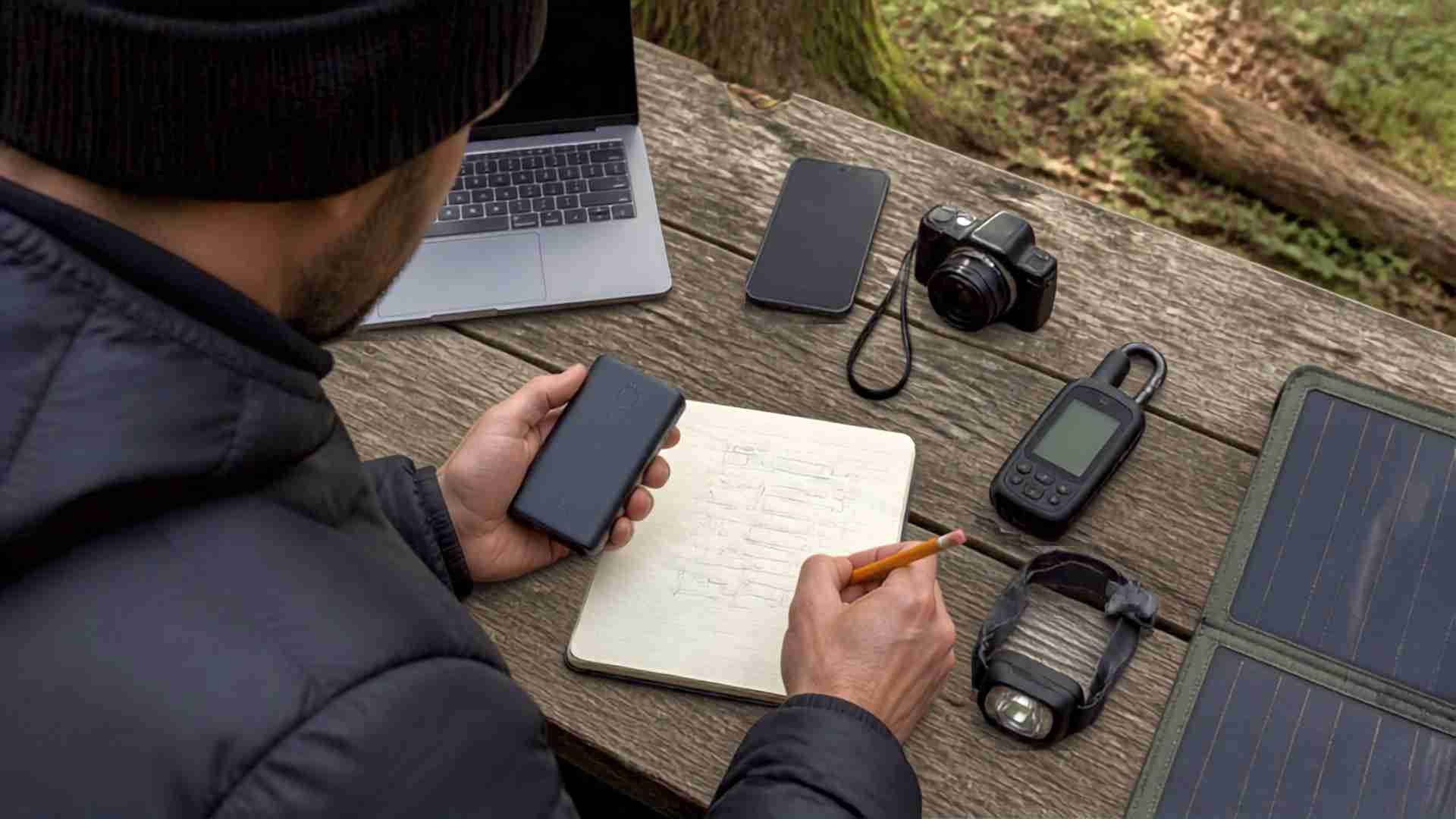
Laptop work, photography and drone flights may be important, but so are navigation, communication and lighting. The last available charge should not be used for another hour of work or entertainment if it may be needed later for a phone, GPS device, satellite communicator or headlamp.
A short trip is different from a repeatable routine
A setup that is sufficient for one day may fail during a longer journey. Several cloudy days, less driving than expected or heavier device use can gradually reduce the reserve. A larger battery delays the shortage, but cannot correct a routine that repeatedly consumes more energy than the available sources restore.
Off-grid electricity planning therefore affects where the traveller can go, how long they can remain there, how much they carry and when the route must return to reliable electricity.
Where off-grid electricity can come from
Away from the grid, electricity must either be collected during the journey or restored during occasional stops where a power socket is available. The most suitable source depends on how the traveller moves and where they spend the day.
Solar panels
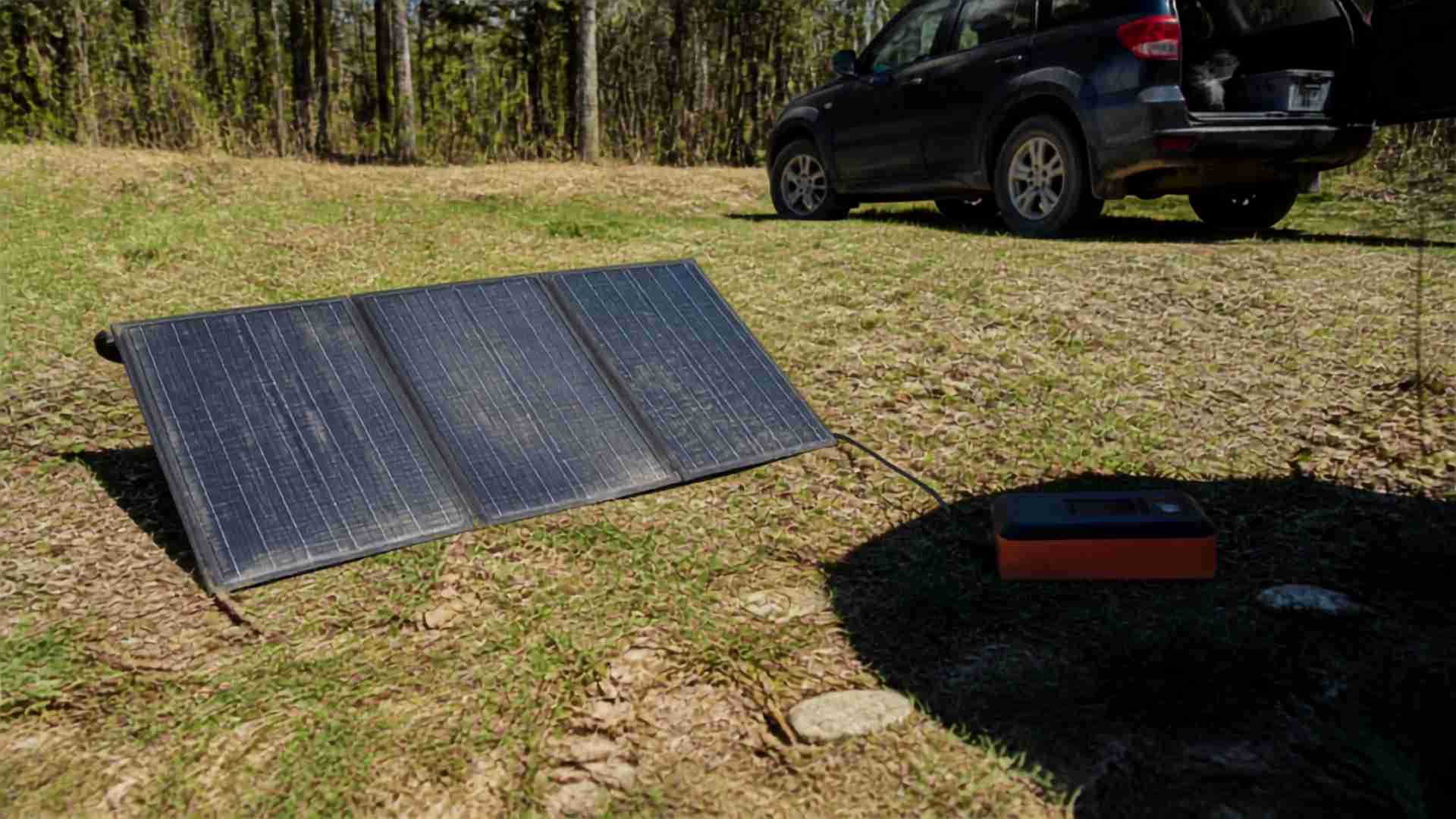
A foldable portable solar panel is most useful when staying in one place for several hours. It can charge a power bank while the traveller is hiking, resting, preparing food or exploring the surrounding area.
Its performance depends on direct sunlight. Clouds, season, location, shade and panel angle all affect the amount of energy that a solar panel can collect. The label shows a maximum under favourable conditions, not constant output. Larger panels collect more energy but add weight and bulk.
A moving vehicle
A car can charge a power bank or other devices through its 12 V socket or a suitable USB-C PD car charger. A modern USB-C Power Delivery car charger can provide much more useful power than a basic USB port or inexpensive FM transmitter, provided that the charger, cable and receiving device support compatible power levels.
This source is more predictable than solar power, but it is available mainly while travelling. Charging therefore becomes connected to driving time and route planning. Running the engine only to produce a small amount of electricity is usually wasteful; it makes more sense to charge during a journey that already has a useful destination.
Occasional access to the grid
Even a largely independent journey may include planned returns to the grid. A hotel, powered campsite, coworking space, station, library or café may provide an opportunity to recharge, where permitted.
These stops can restore several batteries quickly and provide a useful reset after cloudy weather or several days of heavy consumption. They may also influence the route, schedule and budget, especially when an overnight stay is required primarily to regain electricity.
Fuel generators
A portable fuel generator provides dependable power but adds weight, noise and fuel requirements. Its exhaust creates a serious carbon monoxide risk, and a portable generator must never be operated inside a tent, vehicle or other enclosed space. It is generally more appropriate for larger camps or organised expeditions than for lightweight travel.
Other small and emergency sources
A bicycle dynamo can support lights, navigation and slow charging, but not regular laptop work. Hand-crank chargers are emergency tools for a radio, light or limited phone use rather than normal daily sources.
In practice, most independent travellers will rely on some combination of solar charging, vehicle charging and occasional access to the grid. The best balance depends less on the equipment itself than on whether the journey involves long stays, frequent driving or travel on foot.
Storage: the bridge between generation and use
Electricity is not always produced when it is needed. A solar panel may work while the traveller is away from camp, but the laptop may be used after sunset. A vehicle may provide power while moving, but not after the engine is switched off. Storage connects these different moments.
Power banks, power stations and vehicle batteries
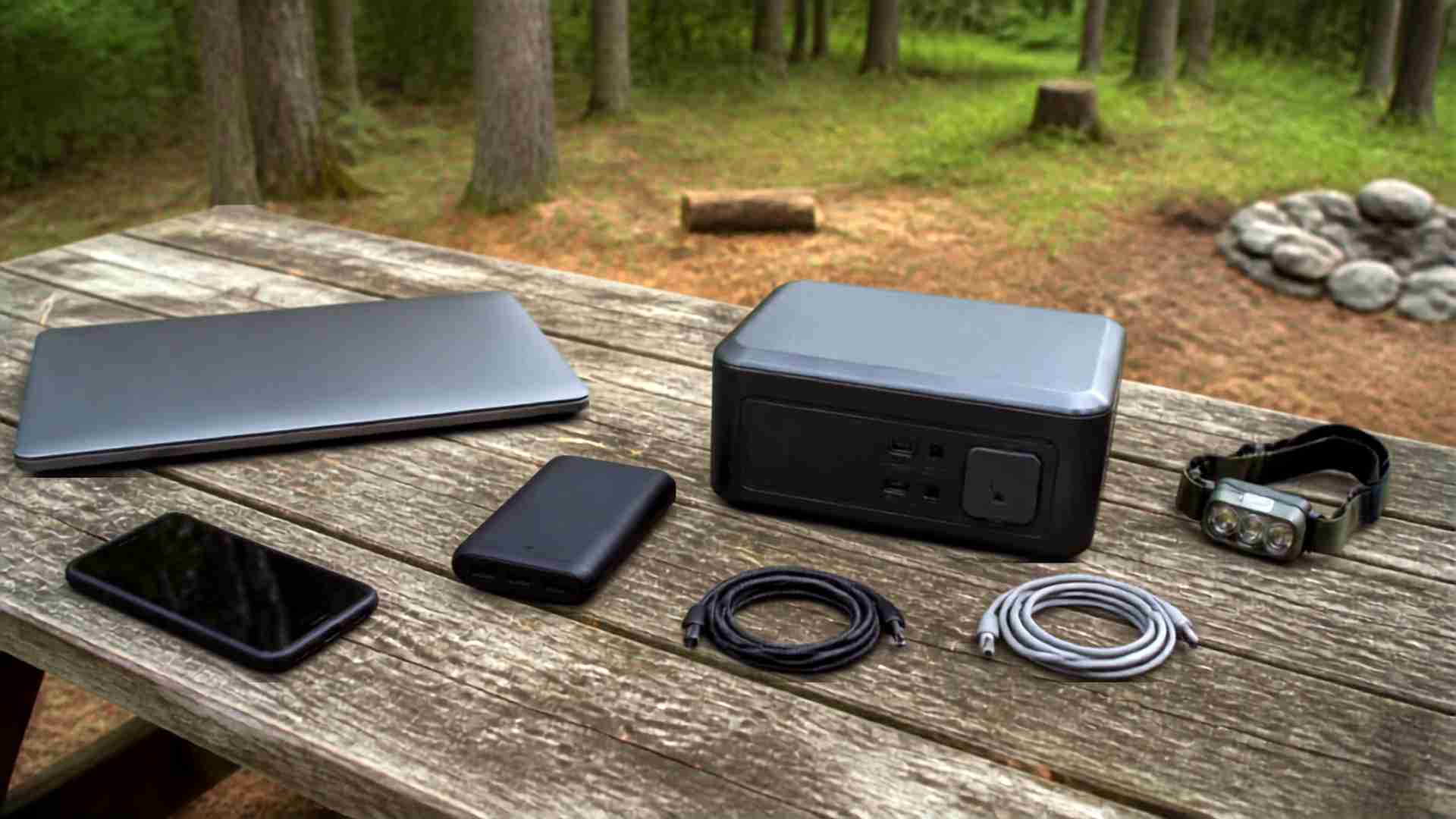
A power bank is usually the lightest and simplest option. Smaller models are suitable for phones, lights and navigation devices, while high-capacity USB-C PD power banks can also charge compatible laptops. A portable power station is larger and heavier, but normally provides more capacity, more connections and sometimes an AC socket for equipment that cannot charge through USB.
The laptop’s internal battery is also part of the available reserve. Beginning the journey with both the laptop and the external battery fully charged provides more working time than counting the power bank alone. Vehicle-based travellers may have an additional leisure battery, separate from the vehicle’s starter battery, but this is a more permanent installation than most occasional travellers need.
Read capacity in watt-hours
Battery capacity is most usefully compared in watt-hours, written as Wh. This number describes how much energy the battery is designed to store. The widely advertised mAh figure is less useful on its own because it does not include the battery voltage. When both numbers appear on the label, Wh is normally the clearer number for comparing different products and estimating laptop use.
Advertised capacity is not fully usable
The full advertised capacity will not reach the connected devices. Some energy is lost while the battery is charged, stored, converted to another voltage and delivered through a cable. Battery age, temperature and high-power use can reduce the result further. It is therefore safer to plan for less than the number printed on the label and to keep part of the remaining charge as an emergency reserve.
One large battery or two smaller ones?
More storage extends the time between charging opportunities, but it also adds weight, volume and cost. This matters little in a vehicle and much more on a walking or cycling route. Two smaller power banks may offer flexibility and backup if one fails, while one larger battery is usually simpler to charge and manage. Compatibility and total usable capacity matter more than the number of separate units.
Storage is a buffer, not a source
Most importantly, additional storage does not create additional electricity. A larger battery can carry a traveller through a cloudy day or delay the effects of an energy shortage. But if the devices repeatedly consume more energy than the solar panel, vehicle or other sources can restore, even the largest practical battery will eventually become empty.
The devices that consume your energy
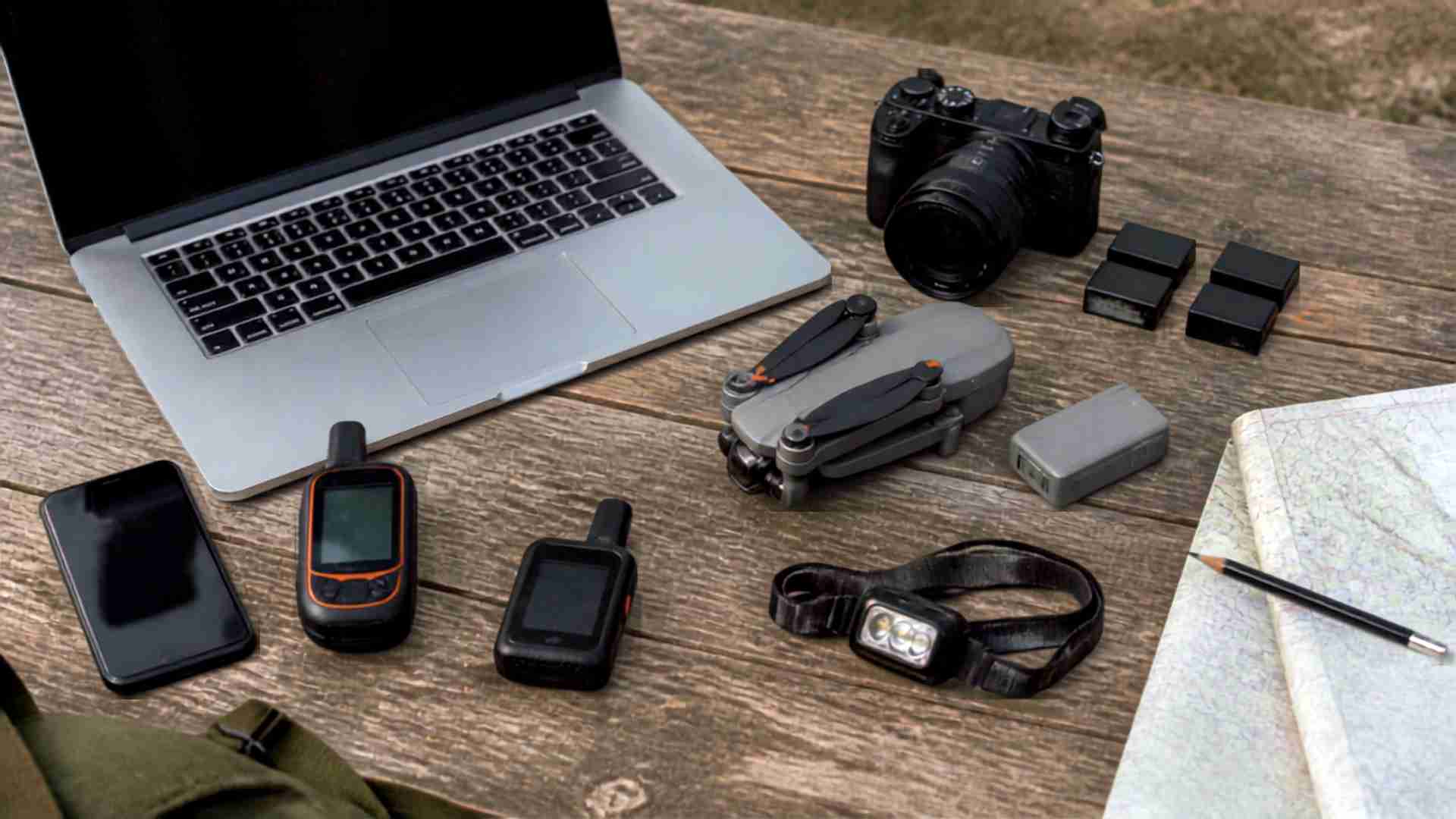
Not every device uses the same amount of electricity, and not every device has the same importance. A useful travel power plan separates equipment into three groups: essential devices, work or activity-related devices, and optional devices. If energy becomes limited, this makes it easier to decide what should be charged first. These devices are only one layer of the special equipment used to explore different environments, alongside shelter, clothing, navigation, water and safety gear.
Laptop
The laptop is often the largest regular consumer. It may also serve route research, photo storage, video editing or entertainment when the journey is not work-related.
The number printed on the laptop charger shows the maximum power that the charger can provide, not what the computer constantly consumes. A laptop supplied with a 90 W or 140 W charger may use much less during light work.
Consumption changes with the activity. Reading, writing and offline tasks require less energy than video calls, photo processing or video rendering. High brightness, background applications, external drives and charging another device increase it further. Gaming and sustained processing may use several times more power than basic writing.
This is why estimated working time should be based on typical use rather than the charger rating alone.
Phone
A phone requires much less energy than a laptop but may be more important. It can provide communication, navigation, weather information, photography, payments and access to bookings or authentication codes.
For that reason, phone charging should be treated as essential. It is better to shorten laptop work or reduce optional use than to begin the next day without enough phone power for navigation and communication.
Cameras and drones
Camera use can be estimated by the number of batteries likely to need charging each day. This depends on shooting intensity, screen use and temperature.
Drone batteries are much larger than typical camera batteries and can become a significant part of the daily energy budget. Several drone flights may consume as much energy as a useful period of laptop work, so they should not be treated as a negligible extra.
Navigation and communication devices
Dedicated GPS units, satellite communicators and radios often consume relatively little electricity, but their importance may be high. On remote routes, they should have their own protected share of the available energy and should not compete with the laptop for the last remaining charge.
Headlamps and camp lighting
A rechargeable headlamp and small camp lights usually require little energy, but they perform an essential safety function. Their batteries should be checked before darkness and included in the emergency reserve, even if they are not charged every day.
Speakers and other optional devices
Portable speakers, tablets, gaming devices and other entertainment equipment may be enjoyable parts of a journey, but they are normally the easiest loads to reduce. When the daily energy supply falls below expectations, optional devices should be limited before work, navigation, communication or lighting.
The aim is not to remove every non-essential comfort. It is to understand what each device contributes to the journey and what can be reduced when the available electricity no longer supports everything.
Estimating how long your system can support you
An off-grid estimate does not need to predict the exact minute when a device will switch off. It should show whether the equipment is broadly sufficient, how much working time is realistic and when another charging opportunity is needed.
The estimate becomes easier if it is divided into six steps.
Step 1: Find the stored energy
Begin with the capacity of the power bank or portable power station. Look for a number followed by Wh, meaning watt-hours. This is the most useful figure for comparing stored energy with the needs of a laptop and other devices.
Many power banks advertise their capacity mainly in mAh. If Wh is also printed on the label, use the Wh figure. If it is missing, check the manufacturer’s specifications rather than trying to compare the mAh number directly with the battery of a laptop or another power station.
Include every battery available at the beginning: the power bank, laptop battery and batteries inside phones, cameras or drones. Keep them separate because energy cannot always be transferred freely between devices.
Step 2: Allow for unusable capacity and losses
The full capacity printed on a battery will not normally reach the device being charged. Some energy remains unavailable near the empty end of the battery, while some is lost in cables, charging circuits and voltage conversion. An AC inverter usually introduces additional losses because the energy is converted more than once.
An older power bank may store less than when it was new, while very cold or hot conditions reduce performance. High-power use may create additional heat.
For an early estimate, assume that only part of the advertised capacity will be useful. Depending on the battery, connection and equipment condition, planning with roughly 70–85% of the nominal capacity is more realistic than expecting the full number on the label. A result measured with your own equipment is better than any general assumption.
Do not include the emergency reserve in the energy available for normal work. If part of the battery must remain for navigation, communication or lighting, treat that part as already unavailable.
USB-C PD or an AC inverter?
The charging path also affects the result. A compatible USB-C Power Delivery connection sends DC power from the battery system to the laptop with relatively few conversion stages. An AC inverter first converts battery power to household-style AC, after which the laptop charger converts it back to DC. The inverter is useful when a laptop cannot charge through USB-C, but the extra conversion normally wastes more energy.
A USB-C-shaped port does not by itself guarantee laptop charging. The power bank, charger, high-power USB-C cable and laptop must support compatible USB-C PD voltages and sufficient power. The weakest part of that chain sets the practical limit.
Step 3: Estimate daily device use
Next, consider how each device will actually be used during a typical day.
Estimate laptop work by activity
For a laptop, the two most important questions are its average consumption during the planned activity and the number of working hours. Light writing and offline reading may use much less energy than video calls, photo processing or video rendering. If a laptop averages about 40 W during a task, two hours of that task require approximately 80 Wh before allowing for further losses.
Count smaller devices by charges
For phones, cameras and other battery-powered equipment, it may be easier to think in terms of charges rather than hours. Ask whether the phone needs a full charge every day, how many camera or drone batteries will be used and whether the headlamp only needs occasional topping up.
Separate essential and optional use
Create a simple daily list and classify each item:
- Essential: phone, navigation, satellite communication and lighting;
- Work or activity-related: laptop, camera, drone and external drives;
- Optional: speakers, gaming devices and other entertainment.
This prevents small devices from being forgotten and shows which use can be reduced if conditions deteriorate. On routes exposed to persistent rain and humidity, protecting electronics in hot, wet and roadless terrain becomes part of the same system, because stored energy is useful only while the devices remain protected and functional.
It is useful to prepare more than one daily profile. A workday, a driving day and a hiking or photography day may have very different energy requirements.
Step 4: Estimate how much energy can be restored
Stored energy shows how long the system can continue without charging. Daily replenishment shows whether that routine can continue beyond the first few days.
Solar charging
For a solar panel, begin with the lowest limit in the charging chain. A 60 W panel connected through a 30 W USB port cannot deliver more than the port allows. The power bank may impose another limit. Then consider how many hours of genuinely useful sunlight the panel is likely to receive—not simply how long the sun is above the horizon.
Prepare separate expectations for clear, mixed and cloudy weather. A carefully positioned panel on an open campsite may perform well, while the same panel attached to a backpack or placed among moving tree shadows may collect much less energy.
Vehicle charging
For vehicle charging, check the output of the actual adapter rather than assuming that every 12 V socket or USB port is equally capable. Estimate how long the vehicle will genuinely be moving. Driving time should come from the route plan, not from an artificial assumption that the engine will run only to charge a power bank.
Planned grid stops
Finally, note any realistic opportunities to use the electrical grid. A hotel night, powered campsite or long stop at a permitted socket can restore several devices at once and reset the system after a period of poor weather.
Step 5: Compare daily consumption with replenishment
Once daily use and daily charging have been estimated, the result will fall into one of three broad situations.
Surplus: More energy is restored than the planned devices consume. The routine may be sustainable, and the remaining energy can rebuild the reserve after a weaker day.
Balanced: Charging roughly replaces daily consumption. The plan may work under the expected conditions, but it has little protection against clouds, extra laptop work or an unplanned change of route.
Deficit: The devices consume more energy than the available sources restore. The journey can still continue for some time by using stored energy, but the reserve will gradually fall. A larger battery extends that period; it does not remove the underlying shortage.
This comparison should be made for several realistic days rather than for ideal conditions alone. A plan that works in perfect sunshine may fail after two cloudy days. A vehicle-based plan may fail when the traveller decides to remain at an attractive location instead of driving.
It is also important to distinguish two different results:
- Initial autonomy: how long the journey can continue using the energy already stored;
- Daily sustainability: whether the available sources can repeatedly replace what is consumed.
A setup may offer excellent initial autonomy but still be unsustainable over a longer journey.
Step 6: Protect essential energy
The final part of the battery should not be counted as another period of laptop work. It should remain available for the devices that support safety and movement.
The appropriate reserve depends on the route. A traveller near towns and regular road traffic may accept a smaller margin than someone crossing a remote area without mobile coverage. In either case, the reserve should cover at least the most important communication, navigation and lighting needs until the next dependable charging opportunity.
When energy becomes scarce, reduce optional devices first, then reconsider heavy work or creative tasks. The system has reached its practical limit when continued laptop use begins to threaten the ability to navigate, communicate or travel safely.
How electricity changes the travel plan
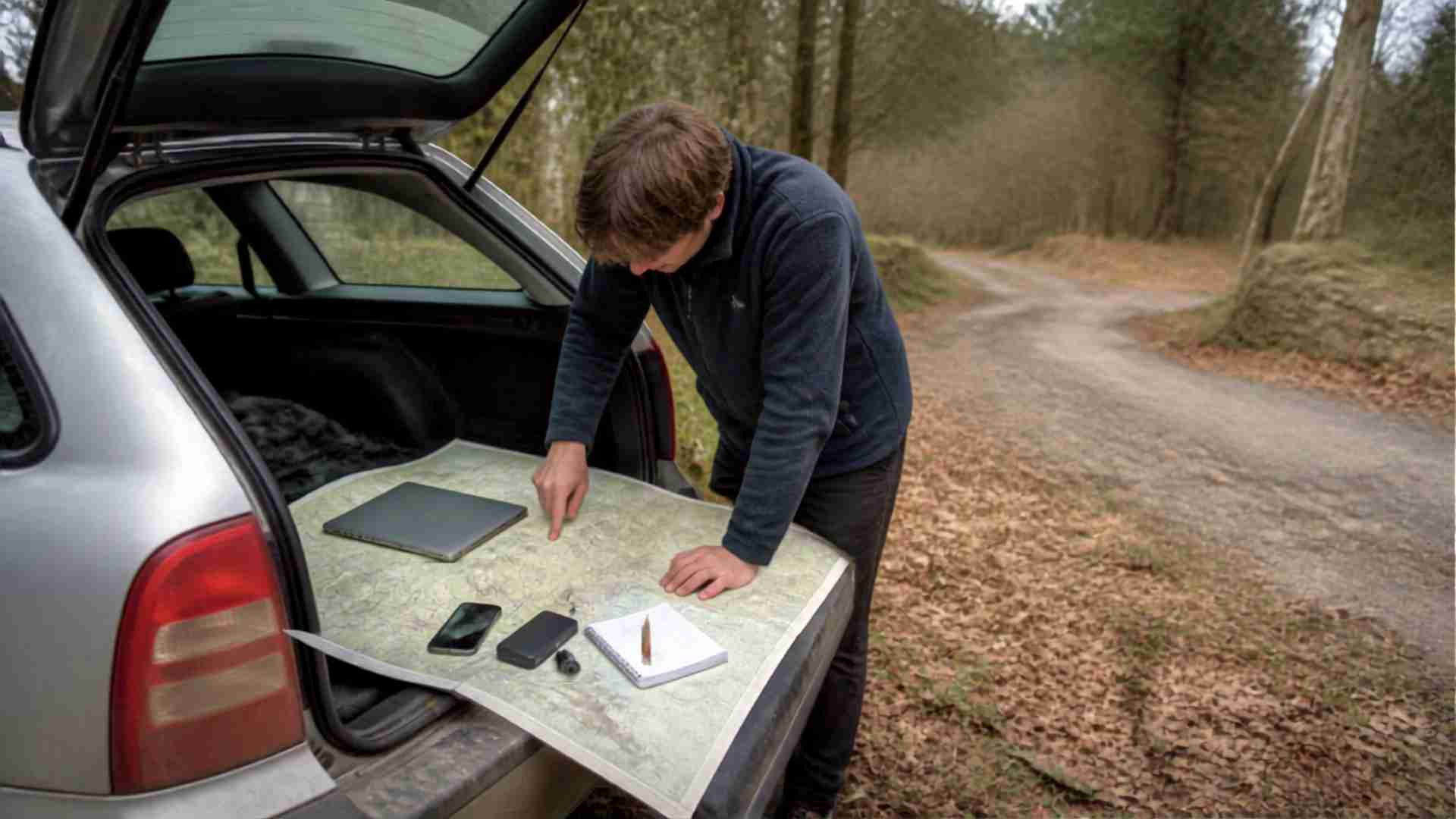
An energy estimate becomes useful when it changes practical decisions: how long to remain in one place, how far to drive, how much equipment to carry and when to return to a town or powered campsite. The central choice is whether work should shape the journey or the journey should shape the working schedule.
When work comes first
Some travellers need five or six productive laptop hours every day, regular video calls or demanding tasks regardless of location. A small power bank may provide backup time, but it is unlikely to support this routine without strong daily replenishment. The traveller may need a larger panel, more storage, faster vehicle charging and periodic grid access.
Time is another limitation. Hours spent working cannot also be used for a long hike, sightseeing or driving. Solar charging may favour a longer stay at an open camp, while vehicle charging favours regular movement. A hotel or powered campsite may become a planned working base rather than an emergency solution.
Energy-intensive tasks such as video rendering, large uploads and charging drone batteries can be grouped on days with reliable power. Writing, reading and route planning can remain for off-grid days. When work comes first, the route must provide the required time, locations and charging opportunities.
When travel comes first
Other travellers place exploration, hiking, photography, driving or rest at the centre of the journey. Work fits into the time that remains. Shorter laptop sessions reduce consumption and may allow a smaller power bank and lighter panel. Suitable tasks can move to the phone, which uses less energy but may be uncomfortable for complex work.
The trade-off is reduced working capacity, but the route gains flexibility. This is especially important on foot: more laptop time may require a larger battery and panel carried over every kilometre and ascent. That energy equipment must share the available carrying capacity with food, water, clothing and an overnight shelter suited to the terrain, so the practical limit is the weight and volume of the complete travel system. At some point, the additional energy equipment begins to diminish the journey it was intended to support. When travel comes first, the route determines how much work is realistic.
The hybrid plan
Many journeys fall between these extremes. A sunny day may favour staying at an open campsite while the panel works and the traveller explores nearby. Laptop work can take place later using the collected energy.
A cloudy day may favour movement. If the route already includes a useful destination, devices can charge while driving. The fuel then serves both the journey and the energy plan instead of running the engine only to produce electricity.
After several weak charging days, a town, hotel or powered campsite can restore the reserve. The same stop can serve high-consumption work, uploads, supplies and route preparation. Solar power supports stationary days, vehicle charging supports moving days, and the grid provides a reset when neither is sufficient.
Routes that continue independently across land and water require an additional energy check at every transport transition, because charging available in a car may disappear when the journey continues by boat, bicycle or on foot.
Electricity as part of route planning
A route plan already considers distance, terrain, time, weather, fuel, accommodation, food, water and places to visit. For a traveller who depends on electronics, energy access belongs on the same list. These energy decisions also affect the real budget of an overland route, because additional driving consumes fuel, while planned grid stops may add campsite, café or accommodation costs.
Before beginning a longer section of the route, it is worth asking:
- How many days will pass before the next dependable socket?
- Will those days involve useful driving or remaining in one place?
- Is the campsite open enough for effective solar charging?
- What happens if the expected sunshine does not appear?
- Which day will include the heaviest laptop, camera or drone use?
- Is there enough reserve for navigation, communication and lighting?
- Where can the full energy supply be restored if the plan falls behind?
On one-way journeys with your own transport, the plan should also identify where the vehicle may be stored, shipped or left behind, because vehicle charging cannot be counted as an energy source beyond that point.
The answers may change the order of destinations or the length of each stay. Clouds may justify moving towards the next useful location; clear days may justify remaining at a good solar camp. A work deadline may require an earlier hotel stop, while a lighter week may allow a longer remote section.
Electricity does not have to control the entire journey. But if the traveller depends on it and ignores it during route planning, the shortage will eventually begin making those decisions instead.
A practical planning example
Consider a traveller using the following equipment:
- one 97.2 Wh power bank;
- one portable solar panel rated at 36 W, with a maximum 30 W USB-C output;
- a performance laptop;
- a phone;
- a camera;
- a rechargeable headlamp.
To keep the example realistic, assume that the laptop averages about 40–50 W during ordinary work. This could include writing, research, email and moderate browser use, but not continuous video rendering or gaming. The phone, camera and headlamp together require approximately 15–20 Wh during a typical day.
The example also assumes that the laptop can charge through a compatible USB-C PD connection. If it requires its original AC charger and an inverter, the available working time will usually be shorter because more energy is lost during conversion.
The laptop’s internal battery is not included in the figures below. A fully charged internal battery would provide additional time at the beginning of the journey, but it is another battery that must eventually be recharged. It improves the initial reserve, not the long-term daily balance.
One day without charging
Although the power bank is rated at 97.2 Wh, the full amount will not reach the devices. After conversion losses and a small protected reserve, a practical estimate is approximately 75–80 Wh of useful energy.
If the phone, camera and headlamp need 15–20 Wh, about 55–65 Wh remain available for the laptop. With an average laptop consumption of 40–50 W, this provides roughly 1.1–1.6 hours of work.
If the smaller devices begin the day fully charged and do not need the power bank, the laptop might receive closer to 1.5–2 hours. Heavy processing, high screen brightness or poor conversion efficiency could reduce that time.
This is the battery-only result. It answers the question: “How long can I continue with the energy already stored?” It does not show whether the same routine can be repeated the next day.
A sunny day at a fixed camp
The solar panel is advertised as 36 W, but its USB-C port can provide no more than 30 W. This lower number is the actual limit before weather, panel position and charging losses are considered.
Under excellent conditions, the empty power bank might be recharged in approximately four to five hours of strong, effective sun. These are not simply four or five hours between sunrise and sunset. They require useful sunlight, limited shade and a reasonably good panel angle.
This creates a practical camp routine. The panel can remain in direct sun while the connected power bank is kept shaded, ventilated and protected from moisture. If the equipment can also be secured from theft or disturbance, it may charge while the traveller explores nearby places. The stored energy can then be used later in the day.
However, the battery remains an important bottleneck. Once the 97.2 Wh power bank is full, any further solar energy has nowhere to go unless another device or battery is connected. Even if the panel could collect more energy during a long clear day, one full power bank still provides only about 75–80 Wh of useful output.
If all laptop work takes place later using this single stored charge, the sustainable laptop time remains approximately 1.1–1.6 hours per sunny day after allowing for the smaller devices. More of the day’s solar production could be used by charging those devices separately while the sun is available, or by adding a second battery to capture energy after the first is full. Direct daytime operation may also help, but only when the equipment explicitly supports that charging arrangement safely.
A cloudy day with vehicle travel
On a cloudy day, solar output may fall too low to restore the power bank. If the traveller is moving to another useful destination, the vehicle can become the main charging source.
The result depends heavily on the car adapter. A basic USB port or inexpensive FM transmitter may provide only modest power. Two hours of driving with an adapter delivering around 18 W might restore roughly 25–30 Wh after losses. A suitable 30 W USB-C PD car charger could restore approximately 45–50 Wh during the same journey.
That may cover the essential devices and a short laptop session, but not a full working day. With the weaker adapter, little may remain for the laptop. With the 30 W charger, approximately half an hour to one hour of laptop work may be realistic, depending on workload and starting charge.
Longer driving would restore more energy, but the route should remain meaningful. Driving only to charge a small power bank turns electricity into an unnecessary fuel expense. A better plan combines charging with movement that already serves the journey: reaching the next landscape, town, trailhead, campsite or resupply point.
Trying to work for five hours every day
Five hours of work on a performance laptop averaging 40–50 W require approximately 200–250 Wh for the laptop alone. After adding the phone, camera and headlamp, the complete day may require around 215–270 Wh of useful energy.
The 97.2 Wh power bank cannot store enough energy for that routine. The 36 W panel may be able to refill the power bank on a clear day, but its 30 W output is also too limited to replace 215–270 Wh reliably every day. Several hours of ideal sunshine do not change the storage limit, and a cloudy day makes the deficit much larger.
A fully charged laptop battery and power bank might support a longer first working day, but the system would not restore that energy quickly enough to repeat the schedule. This is the difference between completing five hours once and supporting five hours every day.
What would need to change?
There is no single solution. The traveller can consume less, collect more, store more or return to the grid more often.
A more efficient laptop could make the largest difference. If the work averages 20–30 W instead of 40–50 W, five hours become more realistic. It must still be fast enough for the intended tasks; an underpowered machine that works longer may save less energy than expected.
A larger panel helps only if its output and the battery input accept the additional power. Replacing 36 W with 100 W achieves little if the port still limits the system to 30 W. Panel, port, cable and battery must form a compatible chain.
More storage saves energy from a good day or long drive for later. A portable power station or several hundred watt-hours of usable capacity would provide a more practical buffer than one 97.2 Wh power bank, but storage alone cannot correct a repeated shortage.
A faster USB-C PD car charger collects more during necessary driving. Longer cloudy periods may still require a planned grid stop.
Work can also be reorganised. Writing, communication and planning may move to the phone or a low-power laptop mode. Rendering, large uploads and other demanding tasks can wait for reliable electricity.
For this particular setup, approximately one to one and a half hours of daily laptop work is a realistic starting expectation under good solar conditions while preserving energy for the smaller devices. Reaching five hours consistently requires a different balance of laptop efficiency, solar generation, storage, vehicle charging and occasional grid access—not simply a second identical power bank.
An optional way to compare your scenarios
You can make a useful estimate with the method described above and a simple note or spreadsheet. If you prefer a guided process, JBH Off-Grid Power Planner Lite asks for the same practical information step by step, provides typical values when some equipment details are unknown, marks results based on estimated data as approximate, and compares the current setup with possible changes such as fewer working hours, a more efficient laptop, additional storage, more solar power or faster vehicle charging. The downloadable planner works offline in a normal web browser.
View JBH Off-Grid Power Planner Lite
Conclusion: energy is part of the route
Off-grid electricity is not only an equipment question. It is a question of time, movement, priorities and how much dependence on the next charging point is acceptable.
Complete energy independence is not necessary for every journey. A traveller may rely mainly on solar power, collect electricity while driving or return to the grid at planned intervals. What matters is understanding what the available system can realistically support and recognising when conditions have changed enough to require a different routine.
A good plan identifies which devices are essential, how much energy can safely be used for work or entertainment, and what must remain protected for navigation, communication and lighting. It also accepts that several cloudy days, heavier device use or an unexpected route change may require shorter laptop sessions, more driving or an earlier stop with reliable electricity.
When energy is included in the route from the beginning, these decisions become part of the journey rather than emergency reactions. The aim is not to carry unlimited power, but to travel with enough knowledge and reserve to keep work, exploration and safety in balance.
Affiliate disclosure: This article contains affiliate links. If you make a purchase through one of these links, Journey Beyond the Horizon may earn a commission at no additional cost to you. As an Amazon Associate I earn from qualifying purchases.
Like it? Pin it here⇓! Follow us on Facebook, X and Instagram!
You may also like


Hi, we are Krasen and Ying Ying. Krasen is from Bulgaria, and Ying Ying is from China. We are passionate about geography and history, and we believe that the best way to experience it is by exploring the Earth in reality, not in a school, and not virtually.
So, we created this blog Journey Beyond the Horizon, where we share geographical knowledge, travel guides and tips how to experience it when you explore our planet, and a lot of inspiration.
And we wish you a happy journey, not just virtually, but most of all- in reality.
Enjoy!
Krasen and Ying Ying
Hi, we are Krasen and Ying Ying. Krasen is from Bulgaria, and Ying Ying is from China. We are passionate about geography and history, and we believe that the best way to experience it is by exploring the Earth in reality, not in a school, and not virtually. So, we created this blog Journey Beyond the Horizon, where we share geographical knowledge, travel guides and tips how to experience it when you explore our planet, and a lot of inspiration. And we wish you a happy journey, not just virtually, but most of all- in reality. Enjoy!

